


Oct 26, 2026 | written by: Tommaso Ciuffoletti


For centuries, European folklore has attributed mysterious powers to trees: some protect against witches, others shelter fairies and magical creatures, while still others seem to guard secrets that would be better left undiscovered. In Wales, there is even a tree that, according to legend, knows the names of the dead before they die. And in witches' rituals across much of Europe, sabbats were said to take place around trees, which could be a walnut tree (such as the famous Witch's Walnut Tree of Benevento, the best-known tree in Italian esoteric and inquisitorial tradition, which was felled in 662 AD by Saint Barbatus, Bishop of Benevento, to mark the Lombards' conversion to Christianity), an oak (such as the Witches' Oak in Capannori, near Lucca), or the Linden Tree of Rueglio in Piedmont.
Halloween is a wonderful opportunity to rediscover some of these stories, passed down through generations and preserved to this day. Many of them have connections with Samhain, the ancient Gaelic festival marking the end of the harvest and the beginning of the darkest season of the year. According to the beliefs associated with this festival, the boundary between the world of the living and the supernatural could become thinner.
After all, the woods are a place where we feel like guests. Even when we cannot rationally make out the presences surrounding us, we can still sense them. We know that we are not the masters here: others are. And they may not always have the best intentions towards us humans (and, in some cases, who could blame them?).
Here are seven legends to read before turning out the lights.
1. The Yew Tree That Foretells Death
Llangernyw, Wales. The star of the story: the European yew.
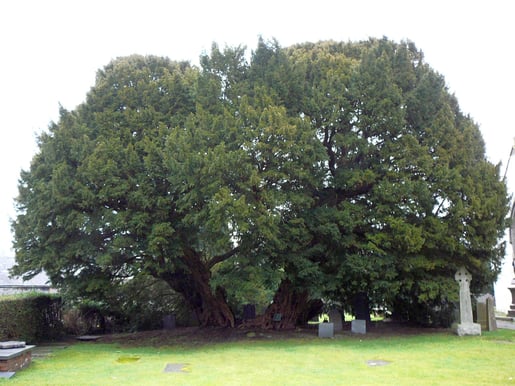
Picture an old Welsh churchyard, an ancient church, and a yew tree with a twisted trunk, its branches seemingly reaching towards the gravestones. According to local legend, this is where Angelystor appears: a mysterious supernatural figure who, every year on Halloween, announces the names of parishioners destined to die in the near future.
The story becomes even more unsettling when a tailor named Shôn ap Robert enters the picture. He did not believe a word of these tales. Convinced they were nonsense, he decided to visit the church on Halloween night to prove there was nothing to fear.
But once he arrived, he heard a voice reciting the names of those who were going to die. His own name was among them.
According to the story, the tailor died within the following year.
The legend is documented in the People's Collection Wales, which preserves material from the Conwy archives. The Llangernyw yew is indeed an ancient tree, although its exact age is difficult to establish.
We do not know whether Angelystor ever really appeared to anyone. But if you happen to pass through that churchyard this coming October 31, keep walking and resist the temptation to listen for someone—or something—calling out names. You would never want to hear yours.
Source: People's Collection Wales – St Digain's Church, Llangernyw.
The Hawthorn Trees of Ireland
Ireland. The star of the story: the hawthorn.
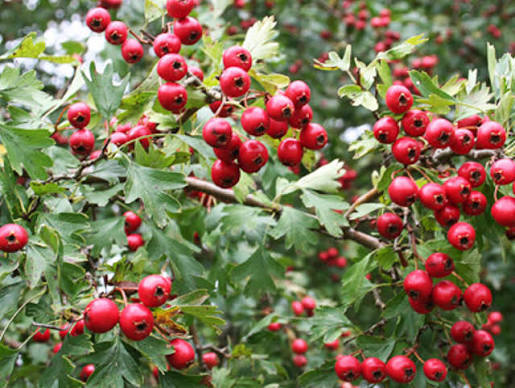
There is an unwritten rule in Irish folklore that is well worth following: if you come across a solitary hawthorn in the middle of a field, leave it alone. This is about more than simply respecting nature. According to numerous folk beliefs, certain hawthorns were home to the little people, the fairies who inhabit an invisible world alongside our own. Cutting down or damaging one of these shrubs could bring bad luck, illness, or even death.
The danger was particularly associated with isolated specimens, those that seem to grow all alone in the middle of nowhere. They were not considered ordinary trees, but places inhabited by beings that humans would be wise not to disturb.
In some Irish traditions, even bringing hawthorn blossom indoors was considered dangerous: it was believed to foretell a death or bring discord into the family.
These beliefs are not exclusive to Halloween. In Ireland, the eve of May Day was also considered a dangerous night associated with the fairy world. So, the next time you come across a hawthorn, the choice is yours: will you leave it alone or take your chances?
Source: University College Cork – Hawthorn folklore.
3. The Yew Tree That Lives Among the Dead
Britain and Ireland. The star of the story: the European yew.
As it turns out, the yew at Llangernyw is not the only tree associated with stories and legends that blur the line between the living and the dead. If there is one tree that looks as though it has stepped straight out of a Gothic novel, it is the yew. Evergreen, long-lived, and capable of developing twisted trunks, it is a familiar presence in British churchyards. Some specimens are so ancient that they may have watched generations come and go while barely changing their appearance.
Its association with death is not easy to explain in a single, definitive way. Its foliage, which remains green even in winter, has certainly helped make it a symbol of continuity and immortality. Its remarkable longevity may also have contributed to this association. And there is another detail: several parts of the tree contain toxic substances, so its berries should never be assumed to be harmless simply because they look inviting.
The result is a tree that seems to stand with one foot in each of two worlds: the world of the living, who walk beneath its branches, and the world of the dead, whose graves rest in its shade.
Source: Woodland Trust – British Trees: Folklore and Mythology.
4. The Willow That Doesn't Just Weep. It Spooks You
British Isles. The star of the story: the willow.
Willows have something melancholy about them, which is hardly surprising given that they are often called weeping willows. Their branches droop towards the ground, sway in the wind, and often brush the watercourses alongside which these trees tend to grow. So it is hardly surprising that, in some British traditions, the willow was considered a tree connected to the supernatural. In Essex folklore, for example, willow branches were hung over doorways to protect homes from marsh witches. Elsewhere, the willow itself was associated with witchcraft and used in spells and potions.
The fact that willows grow near waterways also brings to mind the many legends inspired by rivers and streams. From stories about the spirits that inhabit them to tales claiming that vampires—and ghosts in general—cannot cross running water, supernatural beings are often forced to linger on riverbanks or near bridges, waiting for a way across. And on damp nights in particular, the mist rising from the water could easily be mistaken for a ghost, as many supposed supernatural sightings seem to suggest.
Willows also feature in many stories in which trees can move or chase travellers. Such tales belong to the more fantastical side of folklore, although it is difficult to trace every version back to a precise historical source. It is therefore better to treat them as folkloric images rather than as a single, well-documented British legend. The connection between the real tree and these stories is easy to imagine: the willow's light, drooping branches sway even in the gentlest breeze.
The willow has long had a mysterious reputation. So, the next time you see its branches moving in the darkness, remember that the wind might not be the only explanation.
Source: The Metropolitan Museum of Art – Tales and a Tune of the Willow.
The Red Rowan That Keeps Witches Away
Scotland and Ireland. The star of the story: the rowan.
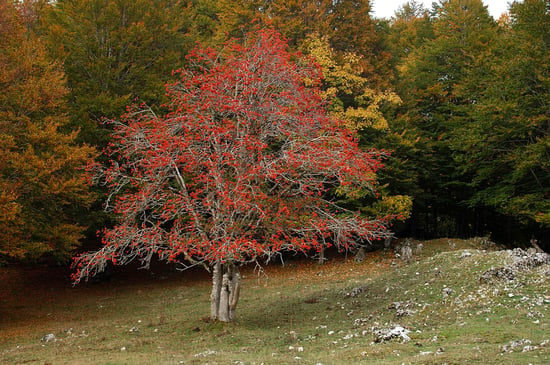
The rowan's red berries look like tiny lights glowing among the autumn leaves. In Scotland and Ireland, however, their colour had a meaning that went far beyond the beauty of the landscape: according to tradition, it could protect people from evil forces (the opposite of what happens in the 2004 film The Village, in which red is forbidden because it attracts the malevolent creatures of the woods).
The rowan, also known as the rowan tree, was considered a protective tree against witches, spirits, and fairies. In some places, it was planted near houses; elsewhere, branches were hung above doors and in barns. There was even a custom of making small crosses from rowan wood and tying them with red thread. They were worn as amulets or placed wherever people wanted to keep unwanted presences at bay.
The berries' red colour was considered particularly effective against evil. And there was another rule: in some Scottish traditions, cutting down a rowan tree was something to be avoided at all costs.
It is curious to think that a tree so important to wildlife was also considered an ally against witches. Its berries, after all, provide a valuable source of food for many birds in autumn. So the rowan has a double reputation: on the one hand, it feeds animals; on the other, according to folklore, it protects humans from whatever lurks in the darkness.
If we had to choose a tree to keep by the front door on Halloween night, this might be the one.
Source: Woodland Trust – Rowan.
6. Mandrake: The Plant That Screams
Medieval Europe. The star of the story: mandrake.
It is not a tree, but it would be a shame to leave it out of this story. Mandrake is a herbaceous plant whose root can vaguely resemble a human figure. For centuries, it has been associated with magic, witchcraft, and mysterious powers. In the Middle Ages, it was considered one of the most unsettling plants in European magical lore. Even Niccolò Machiavelli gave its name to a comedy, playing on the plant's supposed aphrodisiac properties.
The most famous legend is also the most terrifying: when pulled out of the ground, the mandrake was said to emit a scream capable of killing anyone who heard it. Without the deadly element of the story, this legend even made its way into a famous scene in the Harry Potter films.
So how could anyone harvest it without dying? According to some accounts, the plant had to be tied to a dog, which was then lured away from the spot where it grew. When the dog pulled the root out of the ground, the person harvesting it could remain at a safe distance. Naturally, in some versions of the story, the dog was doomed to a tragic end as well.
The myth has a long documented history. A study published in the Journal of Ethnobiology and Ethnomedicine traces the evolution of beliefs surrounding mandrake and notes that the motif of its deadly scream spread through Europe from the twelfth century onwards.
There is also a more down-to-earth explanation for its sinister reputation: mandrake contains toxic alkaloids that can cause serious effects in the human body. Its real toxicity, combined with the unusual shape of its root, probably helped cement its reputation.
It may not be a tree, but it is hard to imagine a plant better suited to a Halloween story. And just to be on the safe side... it is best to leave it where it is!
Sources: Journal of Ethnobiology and Ethnomedicine – In search of traces of the mandrake myth; Europeana – Mandrake: The Scream of Death.
7. Samhain
Ireland and the Gaelic world. The protagonists: woods, spirits, and ritual fires.
To understand why trees feature so prominently in Halloween stories, we need to take a step back in time, to Samhain. This Gaelic festival marked the end of the harvest and the transition into the darker half of the year. It was celebrated around October 31 and November 1, when the days were growing shorter and winter was approaching.
In traditions associated with Samhain, the boundary between the world of the living and the supernatural could become thinner. The spirits of the dead and fairy folk could interact with human beings, and some stories told of dangerous encounters for those who ventured outside their homes.
Ritual fires played an important role in these celebrations. And although we cannot claim that there was a single Celtic ritual devoted to trees, it is easy to understand why the woods became a favourite setting for such tales. A dark path, a solitary tree, a clearing that seems different from all the others: the natural world offers everything we need to imagine a passage into another realm.
It is important, however, not to confuse folklore with history. Beliefs about Samhain have reached us through sources from different periods, and many traditions now associated with the festival are the result of centuries of cultural change. The connection with Halloween remains fascinating all the same. October 31 is still the night when we like to imagine that the world is a little less predictable, that shadows conceal something, and that the woods are keeping secrets.
Perhaps this is precisely why trees can frighten us so much in stories: they are still and silent, yet they are alive. They are different from us, and we cannot understand their thoughts or intentions. More than even wild animals, they seem like creatures from another world. It is easy to imagine them as benevolent, but it is just as easy to imagine them as hostile. Just think, for example, of the role played by the Ents in J.R.R. Tolkien's The Lord of the Rings.
The next time you walk past an ancient tree, try looking at it for a few seconds longer. You do not have to believe in witches or spirits to feel that some trees seem to belong to a time and a world different from our own.
And if, by any chance, you think you hear a whisper among the branches, do not worry. It is probably just the wind.
Probably.
Sources: NASA – Halloween History; HISTORY – Samhain.
One Last Thing Before We Return to the Light
The stories we have explored show just how long humans have tried to make sense of the woods, the oldest trees, and those aspects of nature they could not explain. Trees can be shelters, sources of nourishment, places of memory, and symbols of protection. But on autumn nights, they can also become the protagonists of stories that make us look at the landscape with different eyes.
So, happy Halloween. And remember: if you come across a solitary tree in the middle of a field, there is no need to run away.
But perhaps it is best to leave it alone. And in that spirit: W Halloween!

