


Nov 16, 2026 | written by: Tommaso Ciuffoletti


In the heart of the Sahara, in Niger, a solitary acacia became a landmark for the caravans crossing the desert. It survived for decades thanks to its deep roots, was respected by travellers and even appeared on maps. Its story came to an end in 1973, but its significance continues to tell us something about the relationship between trees and people.
In the Ténéré Desert, in north-eastern Niger, there was a tree that appeared on maps. It was not an oasis, marked no border and did not indicate the presence of a village. It was an acacia, just a few metres tall, growing in a stretch of sand where no other trees could be found for hundreds of kilometres. Yet, for anyone crossing this part of the Sahara, knowing where it stood could make a real difference.
It was known as L'Arbre du Ténéré. For a long time, it was considered the most isolated tree in the world. Its fame spread far beyond Niger's borders and, when it disappeared in 1973, news of its death received an unusual amount of attention for the loss of a single plant. Its story had already become a legend: that of a tree able to survive where life seemed impossible, respected by generations of travellers and eventually brought down by a motor vehicle. It is a story in which documented facts coexist with accounts that are harder to verify, but which have helped shape the meaning of this extraordinary tree.
An acacia in the middle of the desert
The Ténéré is a vast Saharan region that covers part of Niger and stretches towards Chad. Its name comes from a Tuareg word, tinariwen, referring to desert plains or, more simply, the desert itself. It is a landscape of dunes and expanses of sand, with extreme climatic conditions, very little rainfall and sparse vegetation.
This is where the tree that would become famous as the Tree of Ténéré grew. Its seemingly generic name was, in fact, a reflection of just how exceptional it was in an environment where the growth of a tree was highly unlikely. It was an acacia, most probably identified as Acacia tortilis subsp. raddiana, also classified today as Vachellia tortilis subsp. raddiana. A species typical of arid regions of Africa, capable of adapting to difficult environmental conditions and developing very deep root systems.
Its location was exceptional. The most widely circulated accounts state that there were no other trees within a radius of around 400 kilometres. This distance has become inseparable from the tree's fame, although it should not be treated as a definitive scientific measurement: the presence of other isolated acacias in the region, and the very question of how isolation is defined, make it more accurate to describe it as one of the most isolated trees ever known.
Its survival, however, had a concrete explanation. Between 1938 and 1939, during the construction of a well in the area, the French soldiers involved in the work dug to a depth of around 30 metres. There they found water and, according to the account of officer Michel Lesourd, the acacia's roots as well. The tree was therefore able to reach an underground water table, drawing on a resource invisible to anyone crossing the desert's surface.
This is an important detail because it brings the story back to its natural dimension. The acacia did not survive by some miracle: over time, it had developed an extraordinary adaptation strategy, enabling it to find water deep underground. Its presence, however, remained an exception in the surrounding landscape.
The caravans' living lighthouse
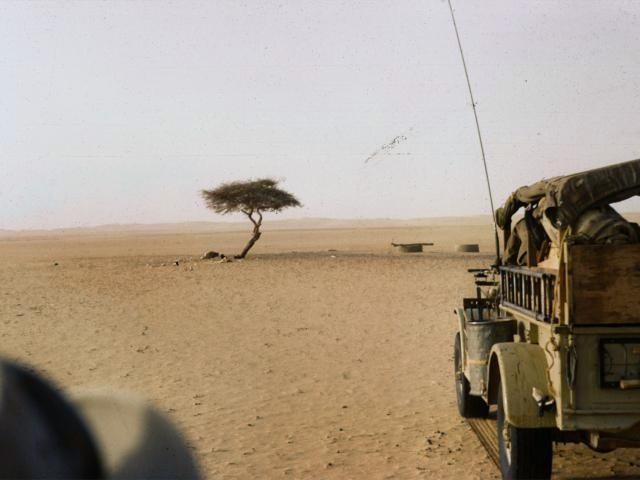
The first particularly significant account of the tree dates back to May 1939. It was written by Michel Lesourd, a French army officer who was in the region overseeing the construction of the well.
In his report, he wondered how the acacia could survive in such a difficult place. How could it still be alive, he asked, despite the passage of camels? Why did the animals not eat its leaves and branches? And why did the many Tuareg leading the caravans not cut off its wood to light fires and prepare tea?
The answer he recorded was surprising: the tree was considered taboo by the caravan travellers. According to Lesourd, there was a kind of shared rule, respected by those crossing the region. Every year, the caravans gathered around the acacia before setting out across the Ténéré.
Lesourd described it as a living lighthouse, the first or last landmark for caravans travelling from Agadez towards Bilma, or making the return journey.
He was referring to the azalai, the great caravans that crossed the Sahara to transport salt extracted from the salt mines of Bilma to markets further inland. These were long and demanding journeys, requiring knowledge of the terrain, navigational skills and careful organisation. In an environment where distances blur and landmarks are scarce, a tree could become an essential presence.
It is worth pointing out that Lesourd's account does not prove that the acacia was the object of a religious cult, nor does it allow us to attribute a single custom to all Tuareg communities. What it does document is something specific: in 1939, a European observer reported that caravan travellers respected the tree and recognised its role in helping them navigate their journeys.
That is already enough to understand how important it was. The acacia had a geographical position, certainly, but it also held a place in the lives of the people crossing the desert. It was a recognisable spot, a meeting place, a presence marking the transition from one part of the journey to the next.
A respected tree, then struck by a truck
French explorer and ethnologist Henri Lhote first encountered the acacia in 1934, during an expedition across the Sahara. He described it as a tree that looked unwell, but was still covered in green leaves and a few yellow flowers.
He came across it again on 26 November 1959, during another expedition. This time, however, he struggled to recognise it. One of its two main trunks had been broken, its canopy was bare and the tree's entire structure had been severely damaged.
In his book L'épopée du Ténéré, published in 1961, Lhote described the discovery in bitter terms. The explanation he was given was simple: a truck travelling towards Bilma had hit the acacia. The vehicle had an entire desert at its disposal in which to pass elsewhere, the explorer wrote in essence, and yet it had struck that very tree.
The detail is particularly striking when set against Lesourd's account. The very tree that caravan travellers were said to respect through a long-standing custom had been damaged by a motor vehicle.
The acacia did not die immediately, however. It continued to live for several more years, despite its mutilated trunk and increasingly fragile structure. Photographs taken between the late 1950s and the early 1970s show a tree reduced to a skeletal presence, but still standing.
The death of the Tree of Ténéré: a truck or a storm?
The year of its disappearance is generally given as 1973. The circumstances of its death, however, are not entirely clear.
The best-known account claims that a Libyan truck driver, supposedly drunk, lost control of his vehicle and crashed into the tree, bringing it down. This version has been repeated in countless later accounts, often embellished with increasingly precise details, such as a night-time journey or a manoeuvre in reverse.
Not all these details, however, are supported by the available sources. A 2018 article in the scientific journal Frontiers in Ecology and the Environment highlighted the uncertainty surrounding the accident, also mentioning an alternative account according to which the tree was brought down by a whirlwind. An article published in the French journal Bois et Forêts des Tropiques in 1974, shortly after the tree's disappearance, under the title L'arbre du Ténéré est mort, is an important reference for reconstructing the events.
Caution is therefore necessary: we know that the tree died in 1973 and that its history had already been marked by an earlier collision with a truck. The exact circumstances of the final incident, and especially the identity and condition of the driver, cannot be presented as definitively established facts.
The remains of the acacia were transported to Niamey, Niger's capital, on 8 November 1973. They were preserved at the National Museum, now the Musée National Boubou Hama, where they are still on display. A metal commemorative structure was erected where the tree had once grown. It recreates its shape and continues to mark its position in the desert.
In 1974, Niger also dedicated a postage stamp to the tree, a sign of how deeply this plant had entered the country's collective imagination.
Why do we still remember a tree?
The story of the Tree of Ténéré could end here: a plant species adapted to extreme conditions, a landmark for caravans, an accident and the preservation of its remains in a museum. And yet, more than fifty years later, we are still telling its story. Why?
Its importance went beyond its ecological function, however remarkable that may have been. The acacia had become part of the experience of those crossing the desert. It had a name, a recognisable location and a shared history. People knew it was there and could count on its presence. It was a feature of the landscape that helped people find their way and brought together, if only for a moment, those travelling along those routes.
The respect attributed to it by caravan travellers, although known mainly through Lesourd's account and later stories, also suggests that its value went beyond immediate usefulness. A tree in such a place was a rare presence, something to be preserved. Its existence had acquired meaning for those who lived and travelled in that territory.
This is one of the most interesting aspects of the story. Trees can become landmarks in people's everyday geography, but also in their memories. They can mark a meeting place, accompany a shared custom or represent a piece of local history. Their value is also built through the relationships they establish with human communities.
The Tree of Ténéré is an extreme case, almost impossible to replicate: a single acacia in an expanse of desert, known to generations of travellers and so important that it appeared on maps. But precisely because of this, it makes something that often goes unnoticed particularly clear. A tree can matter enormously to a place even when it produces no fruit for trade, offers little shade and is not part of a forest.
When the acacia disappeared, more than a plant was lost. A landmark that had accompanied the journeys and memories of many people was gone. The transfer of its remains to Niamey, the monument in the desert and the commemorative stamp are tangible traces of this awareness.
Today, there is no longer an acacia where the tree once grew. There is a metal structure recalling its shape. It is a curious, almost paradoxical sign: to remember a tree, people built something that is not a tree. And yet the monument continues to mark a precise point in the Sahara, just as the acacia once did.
The story of the Tree of Ténéré reminds us that the relationship between trees and people cannot be measured only by the resources trees can provide. Sometimes a plant becomes important simply because it is there, because it is recognisable, because it accompanies a community over time. And when it disappears, its absence can leave a void that no metal structure can truly fill.
AND IF YOU'D LIKE TO PLANT A TREE WITH TREEDOM TOO, CLICK HERE TO EXPLORE ALL THE TREES YOU CAN CHOOSE FROM AND THE MANY COUNTRIES WHERE YOU CAN PLANT THEM

