


Oct 30, 2026 | written by: Tommaso Ciuffoletti


Choosing the right position, watering regularly and applying fertiliser are not always enough. Water quality, humidity and the environmental conditions in our homes can also affect plant health. Here is what to look out for.
When the usual care routines are not enough
When a plant starts showing signs of distress, we almost always ask ourselves the same questions: Is it getting enough light? Am I watering it too much, or perhaps not enough? Have I chosen the right fertiliser? These are perfectly reasonable questions, because light exposure, watering and nutrients are indeed among the most important factors in plant growth.
And yet, sometimes, the answers remain elusive.
That is exactly what happened to me with some Dracaenas. Despite receiving proper care and apparently growing in suitable conditions, they continued to show signs of distress. So I started looking elsewhere, trying to identify other possible causes. One of the things I began to question was the water I was using to water them.
Tap water, although perfectly safe to drink, is not necessarily the best choice for every plant. Its chemical composition depends on its source and on the treatments used to make it safe for human consumption. In my case, switching to a different type of water led to a significant improvement.
That experience made me wonder how many other factors might affect the health of our houseplants without us even taking them into consideration. After all, a plant lives in an environment, constantly interacts with it and responds to its characteristics. Here are eight factors worth knowing about and learning to observe.
1. Water

Let's start with water. We tend to think of it as a neutral element, simply a way of providing our plants with the hydration they need. In reality, its composition can make a significant difference.
Water hardness, for example, mainly refers to the concentration of calcium and magnesium. Alkalinity, on the other hand, measures water's ability to resist changes in pH, generally due to the presence of bicarbonates and carbonates. There is also electrical conductivity, which gives us an indication of the overall amount of dissolved salts, as well as the presence of specific elements such as sodium, chloride and fluoride.
These parameters can affect nutrient availability, gradually alter the characteristics of the growing medium and, at certain concentrations, damage roots or leaves. Some species, including several Dracaena varieties, are particularly sensitive to fluoride accumulation.
How can you spot a potential problem?
Whitish deposits on the surface of the potting mix or around the edges of the pot may indicate salt accumulation. Drying leaf tips and edges, yellowing and slow growth can also be warning signs, although these symptoms may be associated with many other conditions.
What can we do?
- Check the water quality reports published by your local water supplier.
- Use an electrical conductivity meter (these are very simple devices, usually costing around €15–20 and available from various online retailers) to get an indication of the dissolved salts in your water.
- Consider using properly collected rainwater, possibly mixed with tap water.
- Be careful with water softened using domestic ion-exchange systems: calcium and magnesium are often replaced with sodium, which can accumulate in the growing medium and damage plants.
One important point, though: tap water is generally suitable for many houseplants. There is no need to replace it as a precaution. The issue should be assessed in relation to the water's composition and the needs of the particular species you are growing. If you notice problems whose cause is not immediately clear, remember to consider the water too!
Plants that may not appreciate tap water
Not all plants react in the same way to the composition of the water we use to water them. Some tolerate ordinary tap water without any particular problems, while others may be affected by dissolved salts, bicarbonates or specific elements such as fluoride.
Here are some species that deserve a little extra attention:
-
- Calatheas and Marantas: these plants can be sensitive to salt accumulation in the growing medium and to water composition. Dry or brown leaf tips and edges are signs worth looking out for.
- Dracaenas (Dracaena fragrans, Dracaena deremensis): some species are particularly sensitive to fluoride, which can accumulate in the leaves and cause necrosis at the tips and along the margins.
- Spider plants (Chlorophytum comosum): like Dracaenas, they can be sensitive to fluoride and salt accumulation, often developing the characteristic brown, dried-out leaf tips.
- Ferns, such as Adiantum and Nephrolepis: some species may be affected by highly mineralised water or by salt accumulation in the growing medium. However, sensitivity varies from one species to another.
- Gardenias and azaleas: these are acid-loving plants. Water with a high bicarbonate content can gradually raise the pH of the growing medium, making certain nutrients, particularly iron, less available.
- Epiphytic orchids, such as Phalaenopsis: these can be affected by salt accumulation in the growing medium and around their roots. In the wild, they mainly receive rainwater, dew and atmospheric moisture, which generally contain low levels of dissolved minerals.
- Carnivorous plants, such as Dionaea and Drosera: many require water with a very low mineral content. Clean rainwater, distilled water or reverse-osmosis water is generally preferable for these species.
This is not an absolute ranking: sensitivity depends on the species, variety, growing conditions and actual composition of the water. It is also important to distinguish between hardness, alkalinity and salinity: these are different parameters and can have different effects.
By contrast, plants such as Ficus elastica, Monstera deliciosa, Epipremnum aureum (pothos), Sansevieria and Zamioculcas generally tend to tolerate ordinary tap water better, although they are not immune to salt accumulation over time.
2. Humidity
Many of the plants we grow indoors come from tropical and subtropical environments, where atmospheric humidity can be considerably higher than in our homes. This becomes particularly important during winter, when central heating tends to make indoor air drier. This can become a problem for species that require high levels of ambient humidity.
Relative humidity affects transpiration, the process through which plants lose water through the stomata in their leaves. When the air is very dry, a plant may lose water more quickly, increasing the demand for water from its roots.
How can you spot a potential problem?
Dry leaf tips, dehydrated edges and young leaves that struggle to unfurl can all be signs of stress. However, bear in mind that incorrect watering, salt accumulation and root problems can cause similar symptoms.
What can we do?
- Get a hygrometer (around €20–25) to measure the relative humidity in your home.
- Consider using a humidifier, especially during the colder months.
- Group several plants together to create a slightly more humid microclimate.
- Avoid leaving the bottom of the pots sitting in water in their saucers.
Misting the leaves may seem like a simple solution, but its effect on ambient humidity is generally very short-lived. It is better to address the overall conditions in the room.
3. Air currents and draughts
A plant placed near a window, an entrance door or an air-conditioning unit may be exposed to air currents that alter its environmental conditions.
It is not just a matter of cold air. Air movement can increase water loss from the leaves, while sudden temperature changes can cause stress, especially in more sensitive tropical species.
Hot, dry air coming from a radiator can also be a problem.
How can you spot a potential problem?
Leaves that are damaged mainly on the exposed side, localised drying and leaf drop may suggest that the plant is in an unsuitable position. It is worth checking whether the problem appears or gets worse when windows are opened or the heating is switched on.
What can we do?
- Check where your pots are positioned in relation to windows and doors.
- Avoid placing plants directly in the airflow from air conditioners and fans.
- Keep plants away from direct heat sources.
- Still make sure that rooms are properly ventilated.
Avoiding harmful draughts does not mean keeping plants in completely sealed rooms: air circulation is also important to prevent problems associated with excessive humidity.
4. Light
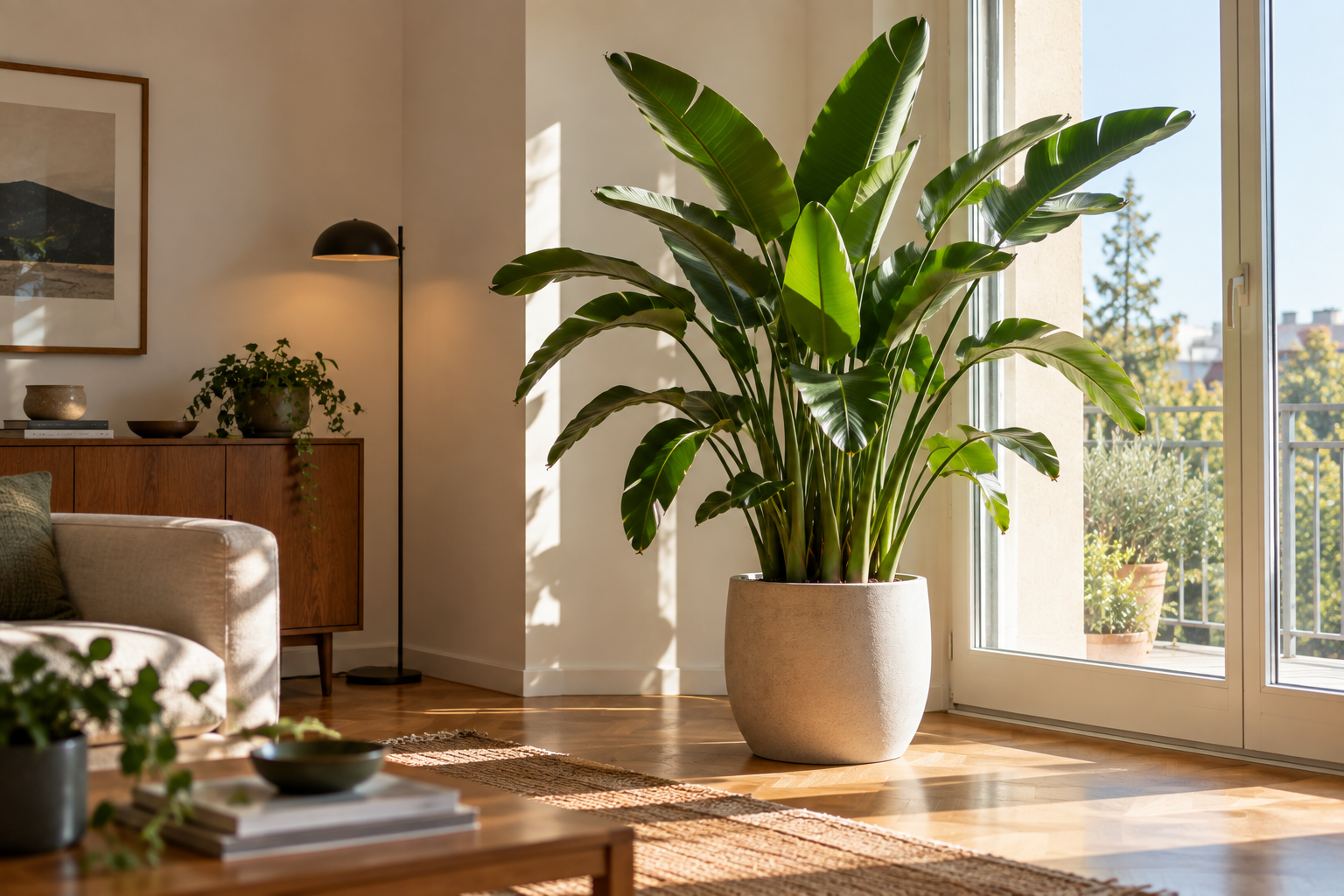
This is probably one of the most interesting aspects of indoor plant care and, at the same time, one of the most underestimated.
We tend to choose a plant's position based on fairly subjective impressions: "There's plenty of light here", "This room is bright", "The sun only comes in during the morning". But the light we perceive with our eyes does not necessarily correspond to the light a plant needs.
There are at least four factors to consider.
- Intensity: how much light actually reaches the leaves.
- Duration: how many hours of light the plant receives each day.
- Quality: which wavelengths are available for photosynthesis.
- Consistency: how much lighting conditions change throughout the day and across the seasons.
Think, for example, of two plants in the same room. One is near a window where the shutters are always open; the other only receives daylight during the hours when we are at home and decide to open them. The difference can be considerable.
Distance from the window also matters enormously: light intensity decreases rapidly as we move away from its source. Curtains, window glass, balconies, trees and nearby buildings can further affect the amount of light available.
There is also an interesting concept called DLI (Daily Light Integral), which measures the total amount of photosynthetically active light a plant receives over the course of a day. It helps us understand why simply extending the hours of illumination is not enough if the light intensity remains too low.
How can you spot a potential problem?
Excessively elongated growth, stems leaning towards the window, smaller new leaves and a general loss of vigour may indicate insufficient light. Conversely, discoloured, bleached or scorched leaves may be the result of excessive exposure, especially when a plant is suddenly moved into direct sunlight.
What can we do?
- Observe how much light reaches the plant at different times of the day.
- Consider its distance from the window, not just the orientation of the room.
- Take seasonal changes into account: a position that works well in summer may become too dark in winter.
- Use smartphone apps that estimate light intensity in lux. They are not precision instruments, but they can help you compare different positions within the same home.
- Consider using dedicated grow lights when natural light is insufficient.
Remember that every species has different requirements: not all tropical plants enjoy direct sunlight, and not all shade-tolerant plants can thrive in a dark corner.
5. Temperature
Indoor temperature may seem like a relatively stable variable, but that is not necessarily the case. A plant placed above a radiator, next to a heater, near a sun-facing window or directly under an air-conditioning vent experiences very different conditions from those indicated by the home's thermostat. Temperature fluctuations can also affect growth and, in some species, encourage or hinder specific stages of development.
How can you spot a potential problem?
Unusual leaf drop, slowed growth and leaf damage can all be signs of temperature stress. It is important to observe when they appear and check whether they coincide with particular environmental conditions.
What can we do?
- Keep plants away from direct heat sources.
- Avoid placing them directly beneath air-conditioning vents.
- Use a thermometer to check the actual temperature in the spot where the plant is growing.
- Find out about the temperature requirements of each individual species.
There is no single ideal temperature for all plants: the needs of a ficus, a tropical orchid and a succulent are not the same.
6. Dust
This is something we often forget, especially when growing plants with large, evergreen leaves.
The leaf surface is where essential processes take place, from photosynthesis to gas exchange. Dust build-up can reduce the amount of light intercepted by the leaves and, when significant, interfere with their proper functioning.
How can you spot a potential problem?
Dull leaves, visible dust deposits and dirt accumulating especially on larger leaf surfaces are easy signs to identify.
What can we do?
- Clean the leaves regularly using a soft cloth and water.
- Support each leaf while cleaning it to avoid damaging it.
- Avoid unnecessary leaf-shine products.
- Take particular care with species that have especially delicate leaves or leaves covered in fine hairs.
A small maintenance task that can make more of a difference than we might think.
7. The growing medium
When a plant shows signs of distress, we tend to look at its leaves and the visible part of the stem. But the problem may be somewhere we rarely look: in the soil itself.
The growing medium is not simply a support in which to place the roots. It must simultaneously provide water availability, oxygenation, structural support and physical and chemical conditions suited to the species. A growing medium that is too compact can retain too much water and reduce the amount of oxygen available to the roots. Conversely, a medium that drains too quickly may dry out rapidly and require more frequent watering.
How can you spot a potential problem?
Potting mix that remains wet for many days, water that struggles to drain away, unpleasant smells and dark, soft roots may indicate drainage and oxygenation problems. Slowed growth and yellowing leaves can also be consequences of root distress.
What can we do?
- Make sure the pot has drainage holes.
- Choose a growing medium suited to the species.
- Check the condition of the growing medium regularly, including below the surface.
- Consider repotting when the growing medium has deteriorated or the roots have run out of space.
One thing to remember: adding a layer of expanded clay pebbles to the bottom of a pot is not enough to solve every drainage problem. The structure and porosity of the entire growing medium are what really matter.
8. Air quality
Let's finish with a less obvious, but interesting factor: air quality.
Houseplants can be exposed to smoke, fumes, volatile substances and other contaminants. Some pollutants can damage leaves, but the effects depend on the substance, its concentration and the duration of exposure.
Think, for example, of plants placed near cookers, sources of smoke or in rooms where spray products are frequently used, particularly for cleaning and disinfecting.
How can you spot a potential problem?
There are no universal symptoms. It is worth observing whether leaf damage appears close to a potential source of contamination or repeatedly occurs under certain conditions when the room is being used.
What can we do?
- Avoid placing plants immediately next to sources of smoke or fumes.
- Ventilate rooms regularly.
- Avoid exposing plants directly to sprays and chemical products.
- Clean leaf surfaces regularly.
One important clarification: we should not confuse plants' sensitivity to certain contaminants with their ability to effectively purify indoor air. Under normal household conditions, there is no evidence that potted plants alone can significantly reduce indoor air pollution.
Before taking action: observe
When a plant is not doing well, the temptation is to take action straight away: change the potting mix, add fertiliser, move it to another room or increase watering. But before doing so, let's pause and take a closer look at the conditions in which it lives.
Here are a few questions worth asking ourselves:
- Have I checked the humidity in the room?
- Do I know the composition of the water I use?
- Is the plant near a radiator, an air conditioner or a window that I open frequently?
- Does it receive natural light for enough hours each day?
- Do lighting conditions change significantly throughout the day?
- Does the growing medium dry out properly?
- Are the leaves clean?
- Is the temperature relatively stable?
You do not necessarily need expensive equipment to carry out these checks. A simple hygrometer with a thermometer, a little attention and, when necessary, an electrical conductivity meter can already help you understand your home's environment better.
There is one final recommendation: try to change one condition at a time. If you change the water, the plant's position, the growing medium and the watering frequency all at once, it will be difficult to understand which intervention actually made a difference.
Looking after plants is not just about watering cans, fertilisers and repotting. It is also an exercise in observation, knowledge and attention towards a living organism that constantly responds to the stimuli in its environment.
Sometimes, to help a plant thrive, we do not need to change our care routine. We simply need to learn to look more closely at the world it lives in.

