



Jul 21, 2026 | written by: Tommaso Ciuffoletti


Digital technologies have often been associated with the idea of being essentially immaterial. It's an understandable perception: compared with the physical media they gradually replaced—books, letters, CDs, DVDs and paper archives—it seemed that a computer and an internet connection were all you needed to access an almost limitless amount of information and services.
Of course, that was never really the case. The internet, cloud computing and digital services have always relied on infrastructure, networks, servers, energy and raw materials. Yet this physical dimension remained largely invisible to most users.
Something similar is happening with artificial intelligence. Here too, the everyday experience feels remarkably effortless: you write a prompt, wait a few seconds, and receive a response, an image, a piece of code or even a video. Behind that apparent simplicity, however, lies one of the most complex and resource-intensive industrial infrastructures ever built.
In recent months, several reports have helped shed light on this hidden dimension with greater precision. Among the most significant is The Environmental Costs of Artificial Intelligence, published in 2026 by the United Nations University – Institute for Water, Environment and Health (UNU-INWEH), alongside the International Energy Agency's (IEA) Energy and AI report and earlier OECD studies on measuring the environmental impact of artificial intelligence.
Although they use different methodologies, these studies reach the same fundamental conclusion: AI is not simply an energy-intensive technology. It is a system that simultaneously consumes electricity, water, land, raw materials and hardware, generating environmental impacts that extend far beyond greenhouse gas emissions alone.
That is not the only important shift in perspective. For years, the debate focused primarily on training large language models, trying to determine how much energy was required to build them. We now know that this is only part of the story. The environmental impact of AI also depends on how it is used every day by hundreds of millions of people, on the kind of content it generates and on the infrastructure that makes its operation possible.
Understanding these impacts gives us the knowledge we need to use AI more consciously. Like every technology that has transformed society, AI can deliver enormous benefits, but it also depends on real-world resources. Understanding the cost of those resources is the first step towards reducing it and, at least in part, helping regenerate the ecosystems on which AI ultimately depends.
AI's Impact Goes Beyond CO₂
One of the main strengths of the report published by the United Nations University is that it broadens the scope of the analysis. Rather than focusing on a single environmental indicator, the authors encourage us to view artificial intelligence as a system that simultaneously mobilises multiple natural resources and, as a result, generates different kinds of environmental impacts.
The first dimension is the climate. Every artificial intelligence model requires electricity both to be trained and to operate. Depending on the energy mix powering data centres, this electricity can result in higher or lower greenhouse gas emissions.
The second dimension is water. Large data centres generate enormous amounts of heat and must be cooled continuously. In many cases, this relies on systems that consume substantial volumes of water, both directly and indirectly throughout the entire electricity supply chain.
The third dimension concerns land use. Data centres occupy increasingly large areas, in addition to the land required to generate electricity, build network infrastructure and extract the raw materials needed to manufacture hardware.
These three dimensions are accompanied by other impacts that are often less visible but no less significant: the extraction of copper, lithium, cobalt and rare earth elements needed for semiconductors; the consumption of highly energy-intensive materials such as ultra-pure silicon; and the growing volume of electronic waste generated by the rapid turnover of computing equipment.
It is no coincidence that the OECD, as early as 2022, called for moving beyond assessments limited to carbon emissions alone, advocating instead for an approach based on the entire life cycle of digital infrastructure. From this perspective, artificial intelligence is not simply software: it is a global industrial supply chain that begins in mines, passes through factories, power grids and data centres, and ends with the decommissioning of servers and electronic components.
Every kilowatt-hour consumed by AI also entails water use, land occupation and material extraction. This is the true environmental footprint of artificial intelligence: not a single metric, but the combined demand for different resources that are taken from ecosystems to make an apparently immaterial service possible.
How Much Does It Cost to Train a Frontier Model?
It is probably the aspect that has attracted the most attention in recent years. Whenever a new large language model is unveiled, one of the first questions concerns the amount of energy required to train it.
The United Nations University report also attempts to answer this question, while highlighting an important limitation: the leading companies developing frontier models still disclose very little information about the actual energy consumption of their infrastructure. The estimates presented in the report are therefore based on calculation models that combine information about the hardware used, processing time and the energy characteristics of the available systems. They are not direct measurements, but they currently represent one of the most robust reconstructions available in the scientific literature.
According to these estimates, training GPT-4 required between 50 and 70 GWh of electricity, generating around 25,000 tonnes of CO₂ equivalent, consuming 600 million litres of water and resulting in a land footprint of approximately 0.9 km².
For GPT-5, the authors project a further increase: 100 GWh of electricity, 42,000 tonnes of CO₂ equivalent, one billion litres of water and a land footprint of approximately 1.5 km².
These are enormous figures, but they are also difficult to visualise.
For this reason, the report proposes a number of comparisons intended purely for illustrative purposes. Among them, the comparison involving trees is probably the most intuitive. According to the authors, absorbing over the course of their growth an amount of carbon equivalent to the emissions associated with training GPT-4 would require around 420,000 trees; for GPT-5, that figure would rise to approximately 700,000 trees.
It is worth pausing for a moment on this comparison, because it is easy to misunderstand.
The report does not argue that planting 420,000 trees would "offset" the training of a large language model. Trees are used as a narrative unit of measurement, a communication choice made by the authors themselves to translate tonnes of carbon dioxide into an image that is easier for non-specialists to grasp.
This distinction is important. Ecosystems do not function like a spreadsheet, where one column automatically cancels out another. Planting trees does not erase the environmental impact of artificial intelligence. It can, however, help regenerate some of the ecological processes that this impact places under pressure: the absorption of atmospheric carbon, soil conservation, regulation of the water cycle, biodiversity protection and the resilience of landscapes.
And it is precisely this idea of regeneration, rather than compensation, that will prove useful when, in the final pages of this article, we ask what concrete contribution each of us can make in the age of artificial intelligence.
The challenge is no longer learning. It's responding.
If, for a long time, the debate around the environmental impact of artificial intelligence focused almost exclusively on the training of large language models, the authors of the United Nations University report argue that this now represents only a relatively small part of the overall picture.
Once training is complete, a model enters what specialists call the inference phase: the stage in which it responds to users' requests. This is what happens every time we ask AI to translate a text, revise a document, write code, generate an image or create a video.
Today, it is this everyday activity - repeated billions of times - that accounts for between 80 and 90% of artificial intelligence's total energy consumption.
This finding fundamentally changes the way we should think about AI. For years, we have asked how much it costs to build these models. Today, we should also begin asking how much it costs to use them.
Because, if the report's estimates are correct, a substantial share of AI's environmental footprint depends not only on the companies that develop these systems. It also depends on how each of us uses them, every single day.
🔴 Billions of prompts, billions of decisions
The authors estimate that ChatGPT now processes around 2.5 billion prompts every day.
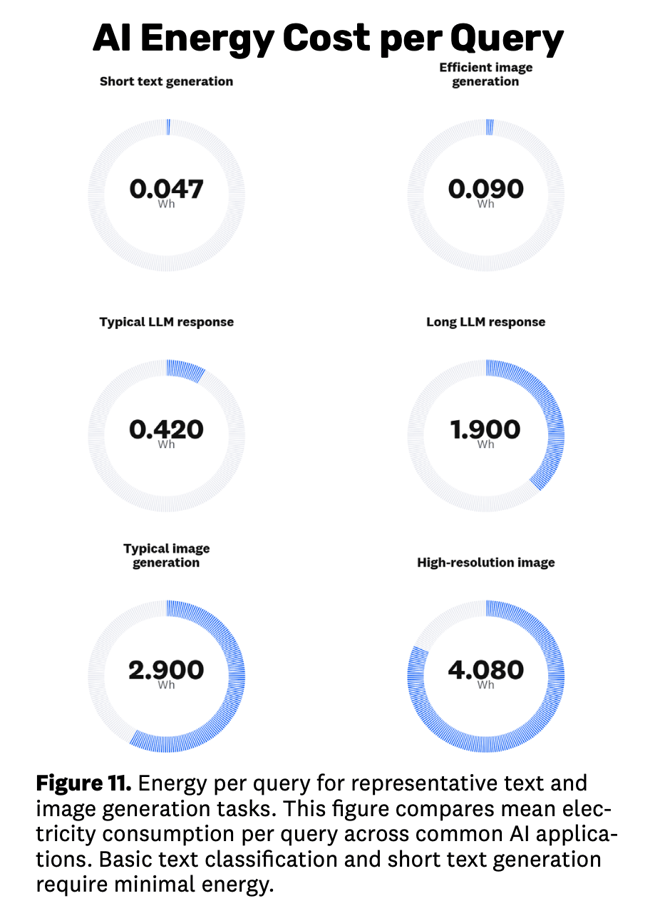
That number may be difficult to grasp. To make it more tangible, the report assumes an average consumption of 0.42 Wh per request. Multiplying this figure by the number of daily interactions results in an annual electricity consumption of approximately 383 GWh, solely to generate responses for ChatGPT users.
This, too, is an estimate. Actual consumption varies depending on the model being used, the complexity of the request, the hardware involved and the data centre processing the prompt. But the underlying message remains the same: the everyday use of artificial intelligence has itself become an energy phenomenon on a global scale.
🔴 Not all requests carry the same weight
One of the report's most original analyses concerns the different energy requirements of the various tasks entrusted to AI. The authors establish a kind of hierarchy of energy consumption, using a very simple operation—text classification, such as identifying a spam message—as a baseline, and comparing it with progressively more demanding applications.
➡️ A text generated by a large language model may require around 200 times the energy needed for a simple classification task. (Classification means choosing between a limited number of predefined options—for example, determining whether an image shows a dog or a cat—whereas generating text requires calculating and producing one word after another, repeating millions of operations until the response is complete.)
➡️ Generating an image can consume around 1,450 times more energy.
➡️ Video generation currently represents one of the most energy-intensive applications. According to the authors, it can require an amount of energy comparable to performing 200,000 text classification operations.
The question, then, is not simply whether we use artificial intelligence, but which kind of AI we are using—and for what purpose.
This distinction is likely to become increasingly important. Just as we now know that an LED light bulb consumes less energy than an incandescent one, or that an A-rated appliance is more efficient than one rated G, in the coming years we will probably also learn to distinguish between AI applications with very different environmental impacts.
After all, every technological revolution has required a cultural shift before a technical one. We have learned to reduce water waste, improve the energy efficiency of our homes, sort our waste and choose more energy-efficient appliances. It is entirely possible that, in the years ahead, we will also begin asking new questions whenever we interact with an AI system: Do I really need to generate a hundred images? Would a text be enough? Do I need the most powerful model available, or could a lighter one achieve the same result?
The Infrastructure Reshaping the Planet
Every request sent to an artificial intelligence system is processed inside a data centre. This is where thousands of processors work simultaneously, performing billions of operations every second and turning a simple prompt into a response that, from the user's perspective, arrives almost instantly.
For years, these infrastructures remained largely invisible in the public debate. Today, their role can no longer be ignored.
The spread of artificial intelligence is fundamentally reshaping the geography of the digital economy. Around the world, new data centres are being planned, investment in electricity grids is increasing, and demand for specialised chips continues to grow, with consequences that extend far beyond the technology sector to energy planning, water resource management and land use.
It is from this perspective that the figures presented in the United Nations University report take on their full significance.
According to the authors' estimates, data centres will consume around 448 TWh of electricity in 2025. To put this into perspective, if they were an independent country, they would already rank as the world's eleventh-largest consumer of electricity. This energy demand is associated with approximately 189 million tonnes of CO₂ equivalent, 4.5 trillion litres of water used throughout the energy supply and cooling cycle, and an estimated 6,900 km² of indirect land footprint.
What is even more striking, however, is the trajectory ahead.
The International Energy Agency's Energy and AI report, published in 2025, reaches a conclusion very similar to that of the United Nations University. By 2030, electricity demand from data centres could exceed 945 TWh, accounting for around 3% of global electricity demand. This convergence is significant because it emerges from different methodologies, reinforcing the credibility of both projections.
Under the same scenario, the UN report estimates that water consumption could reach 9.3 trillion litres, land footprint could exceed 14,500 km², and annual electronic waste generation could rise to as much as 2.5 million tonnes.
These figures tell the story of a profound transformation.
To illustrate its scale, the authors once again propose an easily understandable comparison. They estimate that absorbing, over the course of their growth, an amount of carbon equivalent to the emissions associated with data centres under the 2030 scenario would require approximately 6.7 billion trees. Here again, this is intended purely as an illustrative comparison, not as a proposal for direct offsetting.
Behind every response generated by artificial intelligence lies a network of infrastructure that occupies land, requires raw materials, consumes water and demands energy. The more AI becomes part of everyday life, the more this infrastructure is destined to expand.
An Ecology of Use
▶️ This is where the concept of an ecology of use becomes useful.
For many years, we have thought about sustainability primarily as a question of production: more efficient cars, less energy-intensive appliances, better-insulated buildings. Artificial intelligence reminds us that there is also a sustainability of use.
Every time we decide how to use a technology, we contribute—however infinitesimally, yet genuinely—to shaping its overall demand for energy, infrastructure and natural resources.
It is a principle we already recognise in many other areas. No one believes that turning off the tap while brushing their teeth will, on its own, solve the problem of water scarcity. Yet we know that this gesture matters because millions of individual actions, taken together, change the pressure placed on shared resources.
Something similar is beginning to happen with artificial intelligence. Using it more consciously means recognising that the digital world, like every other human activity, operates within physical limits defined by energy, water, land and raw materials.
This is perhaps the most important cultural challenge posed by artificial intelligence: learning to appreciate its benefits without losing sight of the cost of the resources that make them possible.
From AI Generation to Ecological Regeneration

Artificial intelligence will continue to grow. It is difficult to imagine any other scenario.
Models will become more powerful, they will find their way into an ever-growing number of professions, and they will be increasingly integrated into search engines, productivity tools, design processes, scientific research and, most likely, into the majority of our everyday digital activities.
The question, then, is not whether we should use artificial intelligence. The question is how we should use it.
Our responsibility does not end with reducing waste. It also means helping to strengthen the ecosystems on which the very same digital infrastructure continues to depend.
Trees are not a shortcut for erasing the environmental impact of artificial intelligence. That would be an oversimplification that neither the scientific literature nor this article seeks to support. The authors of the United Nations University report themselves use tree equivalents solely as an illustrative tool to make otherwise difficult-to-grasp orders of magnitude more understandable.
But trees do something real. They absorb atmospheric carbon as they grow. They improve soil fertility. They promote water infiltration and help regulate the water cycle. They support biodiversity. They make ecosystems—and the communities that depend on them—more resilient.
If artificial intelligence generates, trees regenerate. And perhaps regenerate is the verb that best captures the challenge of the age of artificial intelligence.
If AI is destined to become an everyday presence in our lives, then regeneration should also become a daily habit. Not a symbolic gesture performed once to ease our conscience, but an ongoing commitment that grows over time alongside the technologies we use.
For this reason, rather than planting a single tree from time to time, it makes sense to think in terms of a recurring contribution—a way of accompanying technological innovation, month after month, with tangible support for ecosystems.
This is also the idea behind Treedom's subscriptions: not the promise of "offsetting" artificial intelligence, but the opportunity to support agroforestry projects over time—projects that help absorb carbon, protect soils, sustain the water cycle and strengthen biodiversity, mirroring the steady way in which artificial intelligence is becoming part of our daily lives. Treedom's subscriptions were created precisely to transform an occasional gesture into an ongoing commitment. And, in the end, this may be the most important lesson artificial intelligence has to teach us.
For years, we thought of the digital world as something immaterial. Today, we know that it is not. Behind every response generated by an algorithm lie energy, water, land, infrastructure and people.
Innovation does not cease to have a physical footprint simply because we cannot see it.
And that is precisely why every innovation that aspires to endure will have to learn to do something that nature has always known: not only to consume resources, but also, wherever possible, to help regenerate them.
References
-
United Nations University - Institute for Water, Environment and Health (UNU-INWEH) - Aczel, M., Chamanara, S., Matin, M., Farsi, A., Marwala, T., Madani, K. (2026). Environmental Cost of AI's Energy Use: Carbon, Water and Land Footprints. UNU-INWEH - Environmental Cost of AI's Energy Use: Carbon, Water and Land Footprints
-
OECD - OECD (2022). Measuring the Environmental Impacts of Artificial Intelligence Compute and Applications: The AI Footprint. OECD Digital Economy Papers, No. 341. OECD - The AI Footprint
-
International Energy Agency (IEA) - International Energy Agency (2025). Energy and AI. IEA - Energy and AI
-
International Energy Agency (IEA) - International Energy Agency (2024). Electricity 2024 - Analysis and Forecast to 2026. IEA - Electricity 2024
-
Intergovernmental Panel on Climate Change (IPCC) - IPCC (2022). Climate Change 2022: Mitigation of Climate Change (WG III). IPCC Sixth Assessment Report - Mitigation of Climate Change
-
International Resource Panel (UNEP) - International Resource Panel (2024). Global Resources Outlook 2024. UNEP - Global Resources Outlook 2024
-
. United Nations Environment Programme (UNEP) - UNEP - Digital Transformation and Environmental Sustainability UNEP - Digital Transformation
The equivalencies cited in the article (for example, those expressed in terms of the number of trees needed to absorb a given amount of CO₂) are calculated by the authors of the United Nations University report for informational purposes and are intended to help readers grasp very large orders of magnitude. They do not represent a direct measure of offsetting, nor do they imply that planting trees can negate the environmental impact of artificial intelligence. Instead, trees contribute to the regeneration of ecosystems through a wide range of ecosystem services—carbon sequestration, soil conservation, water cycle regulation, and support for biodiversity—that go far beyond the emissions balance alone.

