


Nov 26, 2026 | written by: Tommaso Ciuffoletti


Birch, Oak, Hazel or Willow? According to a curious calendar, each period of the year is associated with a tree, and each tree has its own personality. The tradition isn't quite as ancient as legend would have us believe, but it can be a fun opportunity to get to know some of the tree species that are part of our landscape, and that we sometimes recognise by name alone, without really knowing what they look like. How many people can identify an Alder? Or an Ash? Here's a chance to play and learn to recognise them. It's the same spirit behind our Treedom Horoscope Trees: a way to have fun, discover trees and do something good by planting them. You can find our 2027 Tree Horoscope here, and here you can plant – or give as a gift – the tree associated with each zodiac sign.
But let's get back to the Celtic Tree Horoscope. The idea is simple: each period of the year is associated with a tree, and each tree is assigned certain personality traits. It's a little like the traditional zodiac, except that instead of Aries, Taurus and Pisces, we have Birches, Rowan trees, Ash trees and other members of the plant kingdom.
Of course, we don't need to believe that the day we were born determines our personality. We can use this game as an opportunity to do something much more interesting: discover trees we may encounter quite often but don't know how to recognise. Finding out that we were born under the sign of the Rowan, for example, could be a good reason to learn to identify its leaves, take a closer look at its fruits and look for it on our next walk.
Before consulting the calendar, though, it's worth taking a little journey through history. The Celtic Tree Horoscope has a rather curious backstory and, despite its name, it doesn't seem to be a tradition handed down from the ancient Celts.
Ancient tradition or modern invention?
When it comes to the Celts, trees and nature, it's easy to get carried away by a rather romantic picture of the past. Druids reading the future in oak trees, ancient lunar calendars, secret alphabets and forests considered natural temples: these are evocative images, but they don't always reflect what we actually know about history.
Let's start with a fact: trees did play an important role in Celtic societies, just as they did in many other ancient and not-so-ancient cultures. Plant species were essential for food, construction, toolmaking, medicine and land management. Some trees also held particular symbolic and legal significance in medieval Irish traditions. Oak, Hazel, Apple and Yew, for example, appear in texts that testify to the importance attached to different tree species.
There is another historical element that helped shape the imagery behind the tree horoscope: the Ogham alphabet.
The Ogham alphabet and its connection with trees
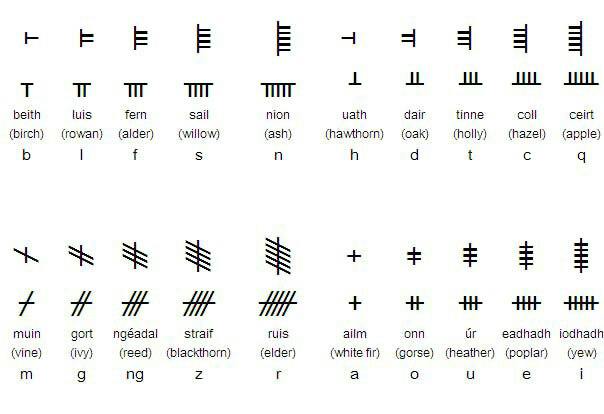
Ogham is an ancient writing system used mainly in the British Isles, particularly in Ireland. Its earliest inscriptions, often carved along the edges of upright stones, generally date from between the 4th and 6th centuries AD.
Ogham characters consist of groups of strokes arranged along a central line. Some of the names given to its letters do indeed correspond to tree names: Beithe means Birch, Dair Oak, Coll Hazel, Sail Willow and Fern Alder.
The connection between writing and the plant world is therefore real, but it needs a little clarification. Not all Ogham letters derive from the names of tree species, and the idea of an entire alphabet made up of tree names is the result of interpretations that developed over the centuries.
One important medieval source is the Auraicept na n-Éces, an Irish text containing grammatical reflections and traditions about the origins of writing. It also includes a classification of trees into different categories, identifying species considered noble, common, shrubby or herbaceous.
As explained by Deborah Hayden and David Stifter, researchers on the University of Glasgow's OG(H)AM project, the relationship between Ogham and trees also developed through a metaphor: the central line of the writing could be interpreted as the trunk, while the strokes on either side resembled branches. The Irish word fid, meaning tree, also came to be used to refer to a letter.
This is a fascinating cultural connection, but it is not evidence that a tree horoscope existed in ancient times.
Robert Graves and the birth of the tree calendar
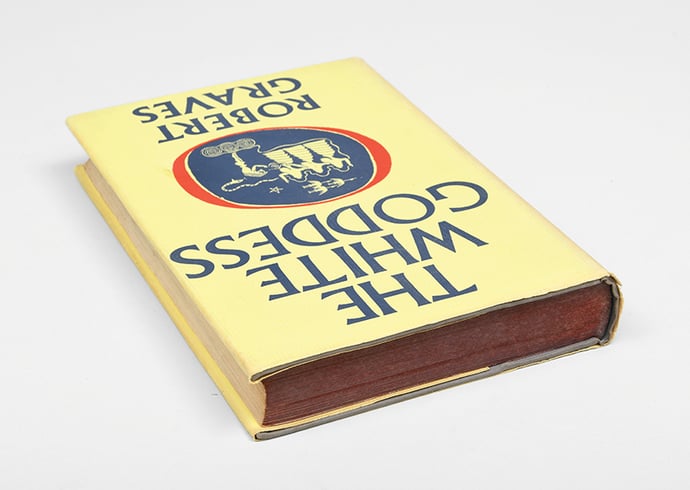
To understand the origins of the Celtic Tree Horoscope as we know it today, we need to jump forward many centuries, to the 20th century. A key figure in this story is Robert Graves, the British poet and writer who published The White Goddess in 1948. In this book, Graves developed a complex mythological interpretation of European poetry, linking ancient deities, lunar rituals, alphabets and the symbolism of trees.
Among his theories was a lunar calendar of thirteen months, each associated with a letter of the Ogham alphabet and a tree. Graves believed he had reconstructed an ancient poetic and ritual tradition connected with Druidic culture.
His theories, however, are not considered reliable by contemporary historical and philological research. There are no ancient sources documenting the existence of a Celtic calendar organised in this way, or a systematic association between birth dates, trees and personality traits.
The story has been examined in detail by Andreas Gregor Heiss and Jutta Leskovar in their academic paper Der keltische Baumkalender – Zur Entwicklung und Rezeption eines Mythos, published in 2013 in the journal Ethnographisch-Archäologische Zeitschrift. The authors document how the Celtic Tree Horoscope is a modern construction that became particularly popular in German-speaking countries during the 1980s, amid a renewed interest in spirituality, neopagan traditions and nature-related imagery.
In short, the tree calendar we find today in books, websites and magazines is not a proven ancient Celtic legacy. It is the result of a modern reinterpretation of historical, literary and symbolic elements.
And perhaps that's what makes it interesting: we can enjoy consulting it without treating it as historical or astrological truth. After all, if the result is learning to recognise an Alder or a Hawthorn, it's still a game worth playing.
The trees of the Celtic horoscope
The 13-tree version is probably the most widespread internationally, although the 22-tree version is also gaining popularity. In the first version, each tree is associated with a period of approximately 28 days, following a structure that recalls the thirteen lunar months. In the 22-tree version, some species appear in several periods of the year, while others are associated with a single day, corresponding to particular seasonal turning points.
We've decided to include both versions. The choice is yours!
In both calendars, each species is assigned certain personality traits and symbolic characteristics. The dates and characteristics below belong to contemporary popular versions of the horoscope: the personality associations are playful interpretations, not descriptions of a documented ancient tradition.
The 22-tree version
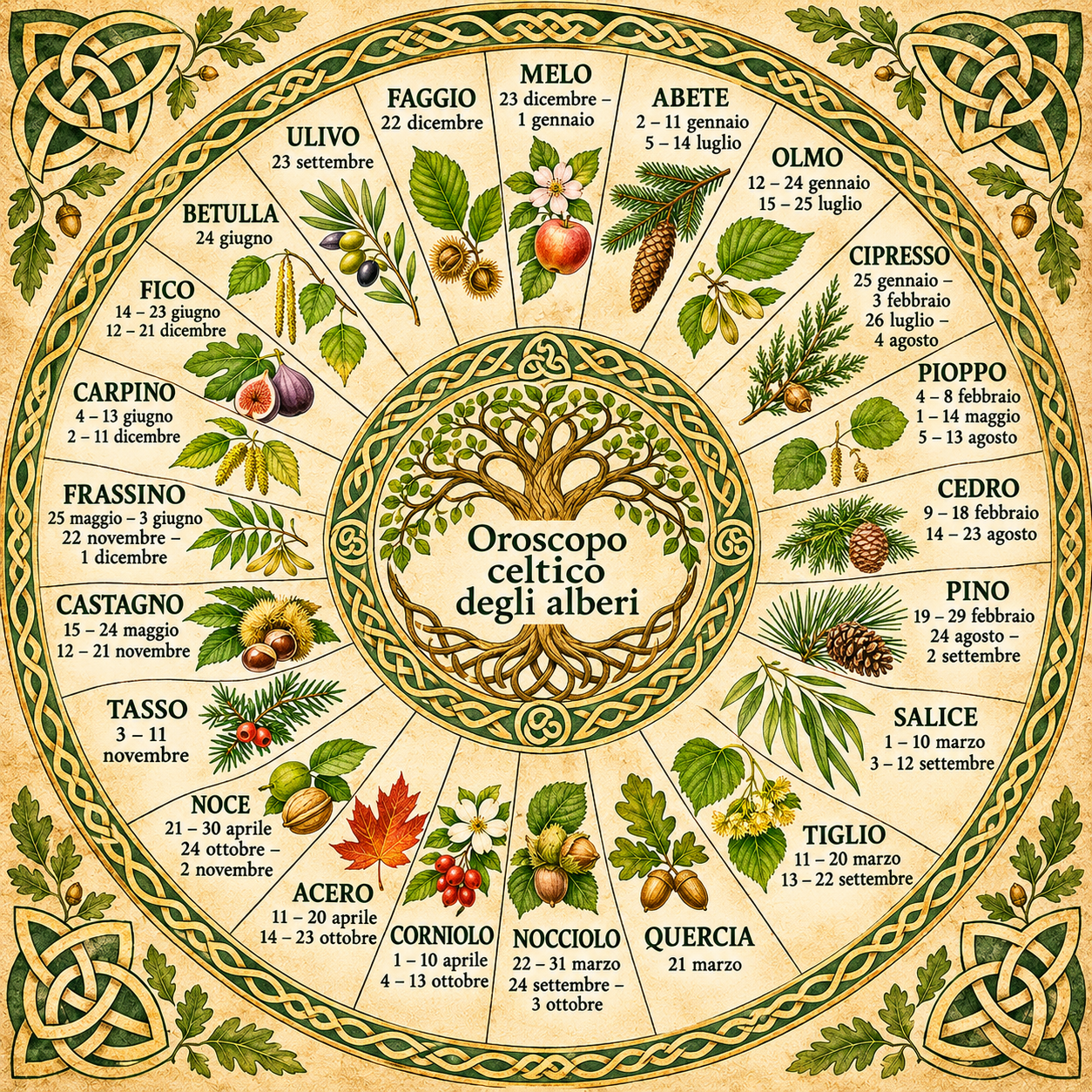
Fir – January 2–11 and July 5–14
The personality: determination and ambition
People born under the sign of the Fir are described as tenacious, rational and ambitious. They have clear goals, enjoy facing challenges and are rarely discouraged. Behind an occasionally rigid exterior, however, lies a sensitive and generous nature.
Getting to know the tree
The European Silver Fir (Abies alba) is an evergreen conifer typical of European mountain forests. It can grow over 40 metres tall and is recognisable by its flat needles, arranged along the sides of the twigs, with two characteristic pale stripes on their undersides. Its cones grow upright on the branches and disintegrate on the tree when mature. It is an important species in mountain forest ecosystems.
Elm – January 12–24 and July 15–25
The personality: generosity and optimism
The Elm represents openness towards others, tolerance and the ability to face life with optimism. People born under this sign are said to be generous, sensitive to injustice and capable of building strong relationships. Sometimes, however, they may put other people's needs before their own.
Getting to know the tree
The Field Elm (Ulmus minor) is a deciduous tree found in the countryside, along hedgerows and in lowland woodlands. It has oval leaves with double-serrated edges and a characteristically asymmetrical base. Its fruits are samaras, small winged fruits that ripen before the leaves appear. It was once widely used as a field boundary tree and as a support for grapevines. Today, many European populations have been affected by Dutch elm disease, a fungal disease spread by beetles.
Cypress – January 25–February 3 and July 26–August 4
The personality: originality and independence
People born under the Cypress are said to be original, independent and not particularly fond of routine. They enjoy following their own ideas and seek experiences that stimulate their curiosity. Their desire to stand out can sometimes make them seem unpredictable, but also makes them fascinating companions.
Getting to know the tree
The Mediterranean Cypress (Cupressus sempervirens) is one of the most characteristic conifers of the Mediterranean landscape. Its tall, slender silhouette is familiar throughout Italy, particularly in Tuscany. It is an evergreen species with tiny scale-like leaves and closely packed twigs. Its fruits are small, woody, rounded cones. It is highly resistant to drought and can live for a very long time.
Poplar – February 4–8, May 1–14 and August 5–13
The personality: reflection and curiosity
The Poplar is associated with thoughtful, observant and curious people. Those born under this sign are said to have a keen analytical mind and a need for security, combined with a desire to discover new places and experiences. A personality that balances practicality with a contemplative spirit.
Getting to know the tree
The genus Populus includes several species found in Italy, including the Black Poplar (Populus nigra), White Poplar (Populus alba) and Aspen (Populus tremula). These are deciduous, fast-growing trees often found along waterways and in alluvial plains. Their leaves vary considerably from one species to another. The Aspen, for example, has flattened leaf stalks that make its leaves tremble even in the slightest breeze. That's where its name comes from.
Cedar – February 9–18 and August 14–23
The personality: creativity and individuality
The Cedar represents flair, creativity and the desire to stand out. People born under this sign are said to be ambitious, lively and unlikely to settle for half measures. They enjoy new experiences and need the freedom to express their individuality.
Getting to know the tree
Cedars belong to the genus Cedrus, a group of large evergreen conifers native to the mountainous regions of the eastern Mediterranean and the Himalayas. The Cedar of Lebanon (Cedrus libani) is perhaps the best known, thanks to its broad crown and horizontally spreading branches. Its needles grow in clusters, while the female cones mature upright and have a distinctive barrel shape. Cedars can live for centuries and grow to impressive sizes.
Pine – February 19–29 and August 24–September 2
The personality: rationality and precision
The Pine is associated with pragmatic, rational people who pay attention to detail. Those born under this sign are said to be methodical, reliable and particularly good at organising their work. The downside? They may leave too little room for spontaneity.
Getting to know the tree
The genus Pinus includes numerous conifer species found throughout the Northern Hemisphere. In Italy, we encounter, among others, the Italian Stone Pine (Pinus pinea), famous for its umbrella-shaped crown and pine nuts, the Maritime Pine (Pinus pinaster) and the Scots Pine (Pinus sylvestris). Their needles generally grow in bundles of two, three or five, depending on the species. Their fruits are cones, which contain the seeds.
Willow – March 1–10 and September 3–12
The personality: intuition and sensitivity
People born under the Willow are associated with an intuitive, sensitive personality and a deep connection with nature. They are said to be dynamic and courageous, but also prone to melancholy and particularly attentive to their own emotions and those of others.
Getting to know the tree
The genus Salix includes hundreds of species, many of which grow in wet environments and along waterways. The White Willow (Salix alba) is one of the most characteristic trees of Italian river landscapes. Its leaves are long and narrow, green on the upper surface and silvery underneath. Its young branches are flexible and traditionally used for basketry and weaving. In spring, it produces inflorescences known as catkins.
Lime – March 11–20 and September 13–22
The personality: kindness and generosity
The Lime tree represents sensitivity, generosity and the value of friendship. People born under this tree are said to be affectionate, helpful and inclined to seek harmony in their relationships. Sometimes, however, they may find it difficult to deal with conflict or make difficult decisions.
Getting to know the tree
The Large-leaved Lime (Tilia platyphyllos) and Small-leaved Lime (Tilia cordata) are deciduous trees found throughout Europe. They can be recognised by their heart-shaped leaves with serrated edges and their small, fragrant flowers, grouped in clusters accompanied by a characteristic elongated bract. They flower between late spring and summer and attract bees and other pollinating insects. Lime trees can become magnificent specimens and live for hundreds of years.
Oak – March 21
The personality: strength and perseverance
The Oak is a symbol of strength, determination and loyalty. People born on this day are said to be tenacious, combative and guided by a strong sense of justice. A strong personality, although sometimes a little too proud.
Getting to know the tree
The genus Quercus includes hundreds of species. Among the most widespread in Italy are the Downy Oak (Quercus pubescens), English Oak (Quercus robur), Turkey Oak (Quercus cerris) and Holm Oak (Quercus ilex). Oaks are essential trees for biodiversity: their crowns host a wide variety of organisms, while their acorns provide an important food source for many animals. They are also among the longest-lived trees in our woodlands.
Hazel – March 22–31 and September 24–October 3
The personality: intelligence and altruism
The Hazel is associated with intelligent, kind people who have little interest in being the centre of attention. Those born under this sign are said to enjoy helping others, to be curious and eager to learn, and always ready to try something new.
Getting to know the tree
The Common Hazel (Corylus avellana) is a shrub or small tree commonly found along woodland edges and in hedgerows. Its leaves are large, rounded and serrated. It flowers very early, between late winter and early spring: its male flowers are the familiar hanging catkins, while its female flowers are tiny and can mainly be recognised by the red filaments emerging from the buds. Its fruits, hazelnuts, are among the best-known wild products of European woodlands.
Cornelian Cherry – April 1–10 and October 4–13
The personality: versatility and the search for harmony
People born under the Cornelian Cherry are said to be versatile, curious and inclined to seek balance. They enjoy learning, exploring new subjects and acquiring new skills. Confusing or conflict-ridden situations may make them uncomfortable.
Getting to know the tree
The Cornelian Cherry (Cornus mas) is a deciduous shrub or small tree found mainly in woodlands and hedgerows across southern Europe. It is one of the first species to flower at the end of winter, when its small yellow flowers appear on bare branches. Its fruits, known as cornelian cherries, are elongated red drupes that ripen in summer. They are edible and have a pleasantly tart flavour, making them suitable for jams and drinks.
Maple – April 11–20 and October 14–23
The personality: independence and initiative
The Maple represents independence, altruism and the desire for freedom. People born under this sign are said to be self-reliant, pragmatic and always looking for new experiences. They dislike feeling restricted and need to maintain their personal space.
Getting to know the tree
The genus Acer includes numerous species, many of which are also found in Italy. The Field Maple (Acer campestre) is common in hedgerows and lowland and hillside woodlands, while the Sycamore Maple (Acer pseudoplatanus) is typical of cooler environments. Their leaves are generally palmate and lobed. Their fruits are paired samaras, with two wings that help them disperse. In autumn, some species put on a spectacular display of yellow, orange and red foliage.
Walnut – April 21–30 and October 24–November 2
The personality: depth and determination
The Walnut is associated with deep, emotional and determined people. Those born under this sign are said to be reluctant to change their minds, but capable of great loyalty and understanding in personal relationships. An intense personality, sometimes difficult to decipher.
Getting to know the tree
The Common Walnut (Juglans regia) is native to Central Asia and has been cultivated in Europe for centuries for its fruits and valuable timber. It can grow to considerable dimensions and develop a broad crown. Its leaves are compound and pinnate, while its fruits are green drupes containing the edible kernel. The leaves and husks contain aromatic compounds and tannins, which have also been used in traditional herbal preparations and dyeing.
Yew – November 3–11
The personality: fantasy and imagination
The Yew is associated with imaginative, intuitive people who enjoy exploring what lies beneath the surface. Those born under this sign are said to have great creativity and an original personality, with a particular interest in mystery and reflection.
Getting to know the tree
The European Yew (Taxus baccata) is a very long-lived evergreen conifer found throughout Europe, including in several mountainous areas of Italy. Unlike most conifers, it does not produce true cones: its seeds are surrounded by a fleshy red structure called an aril. Its needles are flat, soft and arranged in two rows along the twigs. It is a species that requires care: almost all its parts, including the seed, are poisonous to humans, while the fleshy aril surrounding it is non-toxic.
Chestnut – May 15–24 and November 12–21
The personality: generosity and trust
The Chestnut represents altruism, positivity and trust in others. People born under this sign are said to be generous, devoted to those they love and strongly attached to their principles. Their willingness to help, however, can sometimes make them too trusting.
Getting to know the tree
The Sweet Chestnut (Castanea sativa) is a deciduous tree native to the Mediterranean region and western Asia, deeply connected with the agricultural and food history of many Italian regions. It can grow to considerable dimensions and live for centuries. Its leaves are large and lance-shaped, with serrated edges. Its fruits, chestnuts, ripen in autumn inside spiny husks. For centuries, they were a fundamental food source for people living in mountainous and hilly areas.
Ash – May 25–June 3 and November 22–December 1
The personality: energy and competitive spirit
The Ash represents determination, energy and the desire to push beyond one's limits. People born under this sign are said to be positive, courageous and ready to take on new challenges. In personal relationships, they also seek sincerity and commitment.
Getting to know the tree
The Common Ash (Fraxinus excelsior) is a deciduous tree that can grow over 30 metres tall. Its leaves are compound, made up of several pointed leaflets arranged along a central stem. Its fruits are elongated samaras, dispersed by the wind. It is typical of fertile, cool woodlands, often growing alongside oaks, maples and elms.
Hornbeam – June 4–13 and December 2–11
The personality: perseverance and practicality
People born under the Hornbeam are said to be hardworking, precise and determined. They make good use of their time, take their commitments seriously and are not easily distracted. Their determination can sometimes turn into rigidity.
Getting to know the tree
The European Hornbeam (Carpinus betulus) is a deciduous tree found throughout Europe, including in Italian woodlands. It has smooth, grey bark, often marked by fine vertical ridges. Its leaves are oval, with double-serrated edges and very prominent veins. Its fruits are small nuts accompanied by three-lobed bracts that help them disperse. It is also widely used for hedges and avenues.
Fig – June 14–23 and December 12–21
The personality: sensitivity and creativity
The Fig is associated with emotional, creative people who seek stability. Those born under this sign are said to have great expressive potential, but need a supportive environment to make the most of it. In love, they are generous and attentive to their partner's needs.
Getting to know the tree
The Common Fig (Ficus carica) is native to western Asia and has been cultivated in the Mediterranean region for thousands of years. It is a small deciduous tree with large, deeply lobed palmate leaves. Its fruits, figs, are actually infructescences: fleshy structures containing numerous tiny flowers that develop into individual fruits. It is a drought-resistant plant commonly found in Italian rural landscapes.
Birch – June 24
The personality: optimism and adaptability
The Birch is associated with versatile, positive people who can find opportunities even in difficult situations. Those born on this day are said to be resilient and naturally inclined to look ahead.
Getting to know the tree
The Silver Birch (Betula pendula) is easily recognised by its pale bark, which peels away in thin strips as the tree matures. Its leaves are triangular, pointed and serrated. It is a pioneer species, capable of quickly colonising poor soils and disturbed environments. Its small winged fruits are dispersed by the wind.
Apple – June 25–July 4 and December 23–January 1
The personality: idealism and romanticism
The Apple tree represents idealism, energy and the desire to enjoy intense experiences. People born under this sign are said to be romantic, generous and able to combine imagination with practicality. They need to feel involved in the projects and relationships they choose.
Getting to know the tree
The Domestic Apple (Malus domestica) belongs to the Rosaceae family and is one of the most widely cultivated fruit trees in the world. In spring, it is covered with white or pink flowers that attract pollinating insects. Its fruits, apples, come in an extraordinary variety of shapes, sizes and flavours. The Apple tree has been closely linked to European agricultural history and the selection of local varieties for thousands of years.
Olive – September 23
The personality: perseverance and generosity
The Olive tree is associated with determined people who can achieve important goals and put their abilities at the service of the community. Those born on this day are said to be persevering and responsible, although sometimes overly demanding of themselves.
Getting to know the tree
The Olive tree (Olea europaea) is one of the Mediterranean's most iconic trees. It is an evergreen, long-lived species that is particularly resistant to drought. Its leaves are lance-shaped and leathery, dark green on the upper surface and silvery underneath. In spring, it produces small whitish flowers, which develop into olives, drupes that ripen between autumn and winter. Its cultivation has accompanied the history of Mediterranean civilisations for thousands of years.
Beech – December 22
The personality: energy and responsibility
The Beech represents ambition, energy and the desire to take on important responsibilities. People born on this day are said to be organised, determined and focused on results. They may, however, have a tendency to want to control every aspect of their lives.
Getting to know the tree
The European Beech (Fagus sylvatica) is one of the most characteristic trees of European mountain forests. In Italy, it forms extensive woodlands, particularly along the Apennines and the Alps. It has smooth, silvery-grey bark, oval leaves with slightly wavy edges and a broad, shady crown. Its fruits, known as beechnuts, are small triangular seeds enclosed in woody, spiny husks. They provide food for many wild animals.
The 13-tree version
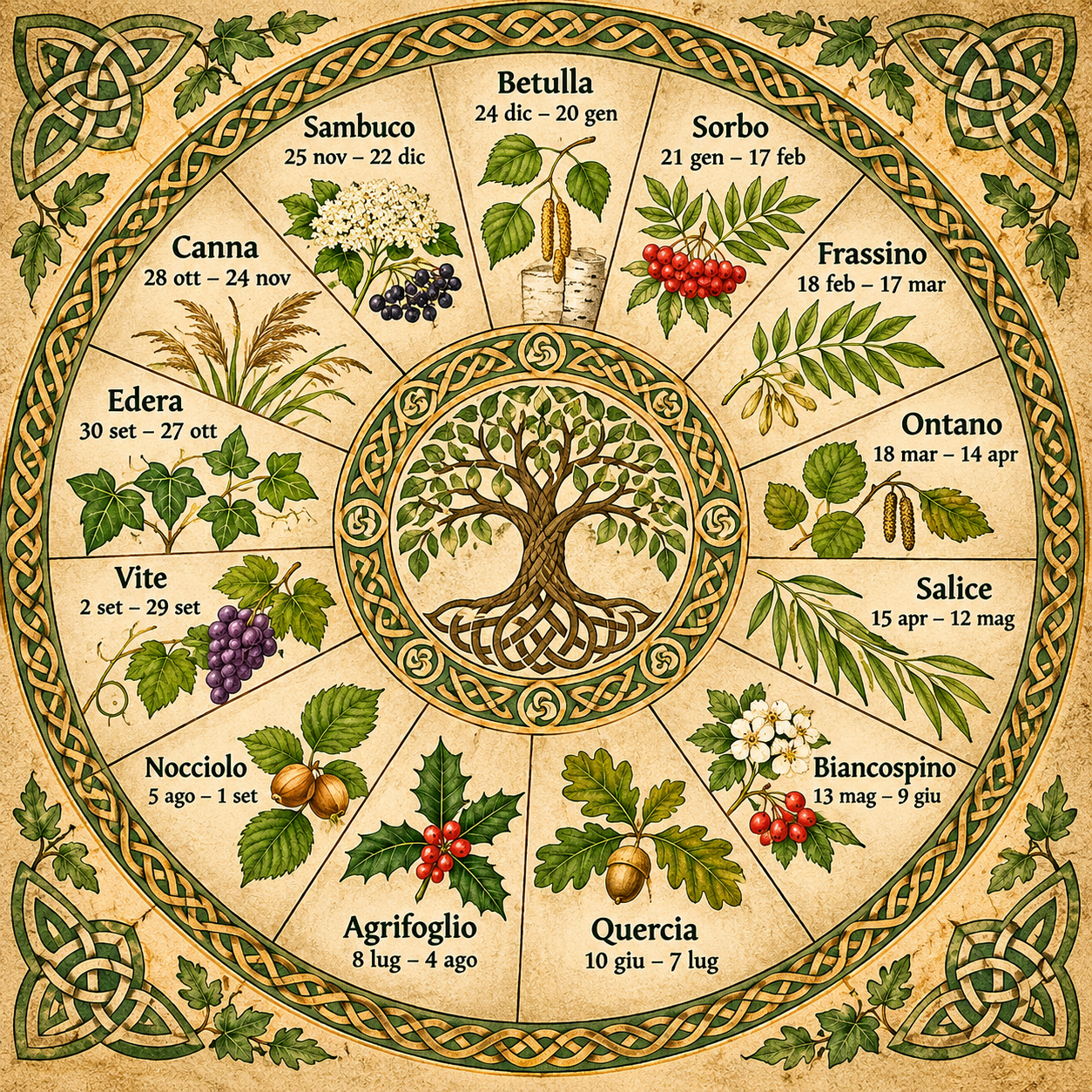
Birch – December 24 / January 20
The personality: determination and initiative
The Birch is associated with determined, ambitious people who can face difficulties pragmatically. Those born under this sign are said to have a natural inclination to take initiative, embrace new challenges and open up paths where others see obstacles.
Getting to know the tree
The Silver Birch (Betula pendula) is easily recognised by its white bark, which peels away in thin strips as it matures. It is a pioneer species, capable of colonising poor soils and disturbed environments. Its leaves are triangular and serrated, while its fruits are small and winged. Its ability to establish itself rapidly in difficult environments has made it a symbol of renewal and new beginnings.
Rowan – January 21 / February 17
The personality: sensitivity and intuition
The Rowan is associated with sensitive, intuitive and creative people. Those born under this tree are said to have a particular gift for observation, an independent mind and an ability to notice details that others might miss.
Getting to know the tree
The Rowan (Sorbus aucuparia) is a relatively small tree found throughout much of Europe. Its leaves are compound, made up of numerous leaflets arranged along a central stem, while in spring it produces clusters of white flowers. In autumn, its characteristic red berries appear, much appreciated by birds. It is an important species for biodiversity and provides food for numerous wild animals.
Ash – February 18 / March 17
The personality: energy and freedom
The Ash represents independence, imagination and the ability to adapt to circumstances. Those born under this sign are said to be curious, energetic and inclined to follow their own path, with little patience for conventions.
Getting to know the tree
The Common Ash (Fraxinus excelsior) is an impressive tree that can grow over 30 metres tall. Its leaves are compound and pinnate, made up of several pointed leaflets. Its fruits, known as samaras, are easily recognised by the wing that helps them disperse in the wind. It is typical of cool, fertile woodlands, often growing alongside oaks, maples and elms.
Alder – March 18 / April 14
The personality: courage and leadership
The Alder is associated with determination, initiative and leadership skills. Those born under this sign are said to be direct, courageous and ready to take on challenges, with a natural inclination to support others.
Getting to know the tree
The Black Alder (Alnus glutinosa) is typical of wet environments and can be found along rivers, streams and in marshy areas. It has distinctive dark bark and rounded leaves, often with a small notch at the tip. Its fruits resemble tiny woody cones that remain on the tree even after the seeds have been dispersed. Its roots host bacteria capable of fixing atmospheric nitrogen, helping to improve soil fertility.
Willow – April 15 / May 12
The personality: sensitivity and imagination
The Willow is associated with empathetic, intuitive people with a vivid imagination. Those born under this tree are said to be particularly sensitive to the feelings of others, with a natural inclination towards creativity and reflection.
Getting to know the tree
The genus Salix includes numerous species, particularly common in wet environments and along waterways. The White Willow (Salix alba) is one of the most characteristic trees of Italian river landscapes. Its leaves are long and narrow, green on the upper surface and silvery underneath. Its branches are flexible and are traditionally used in some species for weaving and basketry.
Hawthorn – May 13 / June 9
The personality: balance and diplomacy
The Hawthorn represents balance, diplomacy and the ability to find solutions even in complicated situations. Those born under this sign are said to be sociable, able to understand different points of view and build lasting relationships.
Getting to know the tree
The Common Hawthorn (Crataegus monogyna) is a small tree or shrub widely found in hedgerows and along woodland edges. Its branches bear thorns, while its leaves have deep divisions forming several lobes. In spring, it is covered in small white flowers grouped in clusters. In autumn, it produces red fruits, known as pomes, which provide food for many bird species.
Oak – June 10 / July 7
The personality: strength and reliability
The Oak is a symbol of stability, generosity and perseverance. Those born under this sign are said to be reliable, protective and endowed with great inner strength. They can face difficulties without losing sight of their goals.
Getting to know the tree
Oaks belong to the genus Quercus, which includes hundreds of species. Among the most widespread in Italy are the Downy Oak (Quercus pubescens), English Oak (Quercus robur) and Turkey Oak (Quercus cerris). They are long-lived trees that can grow to considerable dimensions and host an extraordinary variety of organisms. Acorns are an important food source for many animals, while their crowns provide shelter for insects, birds and small mammals.
Holly – July 8 / August 4
The personality: determination and independence
The Holly is associated with willpower, perseverance and the ability to stay on course even in difficult times. Those born under this sign are said to be independent, ambitious and capable of standing up for their ideas.
Getting to know the tree
The European Holly (Ilex aquifolium) is a small evergreen tree commonly found in broadleaf woodlands and in hilly and mountainous areas. Its leaves are leathery and glossy, often with spiny edges, particularly on the lower branches. Female plants produce characteristic red berries in autumn, which remain throughout winter and provide food for birds. Holly is a dioecious species: male and female flowers grow on separate plants.
Hazel – August 5 / September 1
The personality: intelligence and curiosity
The Hazel represents knowledge, curiosity and observation. Those born under this sign are said to be intelligent, thoughtful and inclined to explore whatever catches their attention. A lively mind, with a particular interest in learning and research.
Getting to know the tree
The Common Hazel (Corylus avellana) is a shrub or small tree commonly found along woodland edges and in rural hedgerows. Its leaves are large, rounded and serrated. It flowers very early, between late winter and early spring: its male flowers are the familiar hanging catkins, while its female flowers are tiny and can be recognised by the red filaments emerging from the buds. Its fruits, hazelnuts, are among the best-known wild products of European woodlands.
Vine – September 2 / September 29
The personality: sensitivity and the search for harmony
The Vine is associated with sensitive, charming people who appreciate beauty. Those born under this sign are said to seek balance, with a versatile personality and a particular appreciation for relationships and life's experiences.
Getting to know the plant
The Common Grapevine (Vitis vinifera) is a climbing plant belonging to the Vitaceae family. It has been cultivated for thousands of years for its fruits, grapes, which are eaten fresh or used to make wine. It climbs using tendrils that allow it to attach itself to supports. Its leaves are palmate and generally divided into five lobes. Its history is deeply connected with Mediterranean farming communities and the development of viticulture in Europe.
Ivy – September 30 / October 27
The personality: adaptability and perseverance
The Ivy represents adaptability, tenacity and loyalty. Those born under this sign are said to be able to face change, maintain strong relationships and find solutions even in the most difficult situations.
Getting to know the plant
Common Ivy (Hedera helix) is an evergreen climbing plant found throughout much of Europe. It climbs trees, walls and rocks using adventitious roots that develop along its stems. Its leaves take different forms depending on the growth stage: those on vegetative branches are generally lobed, while those on adult flowering branches are simpler and more diamond-shaped. In autumn, it produces nectar-rich flowers and, later, dark berries much appreciated by birds.
Reed – October 28 / November 24
The personality: intuition and depth
The Reed is associated with determined, intuitive people who have a particular ability to explore issues in depth. Those born under this sign are said to be inclined towards reflection, the search for truth and careful observation of the world around them.
Getting to know the plant
In this calendar, the name Reed generally refers to the Common Reed (Phragmites australis). It is a large perennial grass found in wetlands, along waterways and on lake shores. It can grow over three metres tall and forms extensive stands thanks to its underground rhizomes. Its inflorescences are large, feathery panicles that take on brownish-purple hues. Reeds play an important role in wetland ecosystems, providing shelter and nesting sites for numerous animal species.
Elder – November 25 / December 22
The personality: generosity and transformation
The Elder is associated with generous, intuitive people who have a particular ability to reinvent themselves. Those born under this sign are said to be curious, open to new experiences and inclined to seek fresh opportunities even when circumstances are difficult.
Getting to know the tree
The Elder (Sambucus nigra) is a shrub or small tree commonly found in the Italian countryside, along hedgerows, at woodland edges and near human settlements. Its leaves are compound, made up of several oval, serrated leaflets. In spring, it produces large, fragrant white flower clusters, followed in summer and autumn by small blackish-purple berries hanging in clusters. Its flowers and ripe fruits are used in many traditional preparations, while other parts of the plant require care because they may contain toxic substances.
So, which tree are you?
Now that we've met all the trees of the Celtic horoscope, we can return to where we started: the game.
Whether you're a determined Birch, a sensitive Willow or a reliable Oak, there's a little experiment worth trying. Next time you go for a walk in a park, a woodland or along a country road, try looking for your tree.
Take a closer look at its leaves, bark, flowers or fruits. Find out what kind of environment it grows in and which animals visit its branches. You might discover that it grows just around the corner from your home and that, until now, you had never really noticed it.
Ultimately, that may be the best thing about this horoscope: turning a little curiosity about our personality into an opportunity to get to know the natural world around us better.
AND IF YOU'D LIKE TO PLANT YOUR OWN TREE WITH TREEDOM, CLICK HERE TO EXPLORE ALL THE TREES YOU CAN CHOOSE FROM AND THE MANY COUNTRIES WHERE THEY CAN BE PLANTED

