
Jun 10, 2026 | written by: Tommaso Ciuffoletti


There’s a simple way to start telling a better story about Africa: look at a map. The kind we all use without thinking. The classic world map, the one hanging in schoolbooks or opened on Google. There, Africa looks big, yes—but not that big. Roughly comparable to Europe, a bit larger than the United States.
That’s wrong.
If you correct the distortion of the Mercator projection—the one that, in order to represent the Earth’s geoid surface on a flat map, enlarges everything near the poles and shrinks what lies along the equator—then Africa changes scale. And you discover that within the African continent you could fit the United States, China, India, and much of Europe, all together.
This isn’t just a cartographic detail. It’s the first error of perspective. Because if you see something as smaller, you also end up thinking of it as different from what it really is.
One continent, many worlds
Even the word “Africa” is convenient. But it’s a shortcut.
Within it, there are vastly different climates, landscapes, economies, and societies: savannas, arid zones, highlands, tropical forests, intensive agricultural systems and others based purely on subsistence. And above all, hundreds of millions of people interacting with these territories every day. There are many different peoples.
Reducing all this to a single image—often natural, “wild,” static—is a simplification that doesn’t hold. And this leads to the second misunderstanding.
“But isn’t it already full of trees?”
It’s a question we receive often. I can guarantee it—I’ve spent years reading and replying to all kinds of comments on our communication channels. In a way, it’s a reasonable question… if you start from the wrong image.
If you think of Africa as one vast forest, planting trees can seem almost unnecessary. But that vast forest, in most cases, doesn’t exist. It’s an image born of simplification—one that, among other things, forgets that Africa is home to the largest hot desert on the planet.
Even more interesting is the fact that a growing share of Africa’s trees today are not found in “classic” forests, but in agricultural contexts. According to increasingly accurate estimates, about one tree in three grows within cultivated systems. These are the “invisible” trees: they don’t make postcard landscapes, but they make fields work.
And this is where the conversation shifts.
The pressure you don’t see
.jpg?width=1272&height=850&name=Kenya_Animals-26%20(1).jpg)
Africa is the youngest continent on the planet. And the one that will grow the most demographically in the coming decades. This means something very concrete: more people living, working, and farming the same lands.
Pressure on ecosystems is not an abstraction. It takes the form of expanding fields, spreading pastures, soils worked more intensively to produce food and income.
And in this context, trees become fragile.
Not only because of climate change—though that plays a role—but because of much more everyday dynamics: grazing animals, for example, which can compromise the natural regeneration of young trees. An unprotected sapling has little chance of becoming a mature tree.
It’s a counterintuitive but central point: it’s not just about planting trees. It’s about allowing them to grow.
When people talk about reforestation, they often imagine large, compact forests. In many cases, that’s a fundamental solution, especially where forest ecosystems have been degraded. But not all territories function in the same way.
In many areas of Sub-Saharan Africa, the landscape is already deeply intertwined with agriculture and the lives of local communities. This is where a complementary approach comes into play: agroforestry. Trees and crops coexist in the same space. Trees protect the soil from erosion, improve fertility, retain water, and create more stable microclimates. Crops, in turn, make the system productive and sustainable over time.
It’s not an alternative to reforestation, but a response suited to different contexts. And above all, it works because it makes sense for those who live on these lands every day.
A future being shaped now
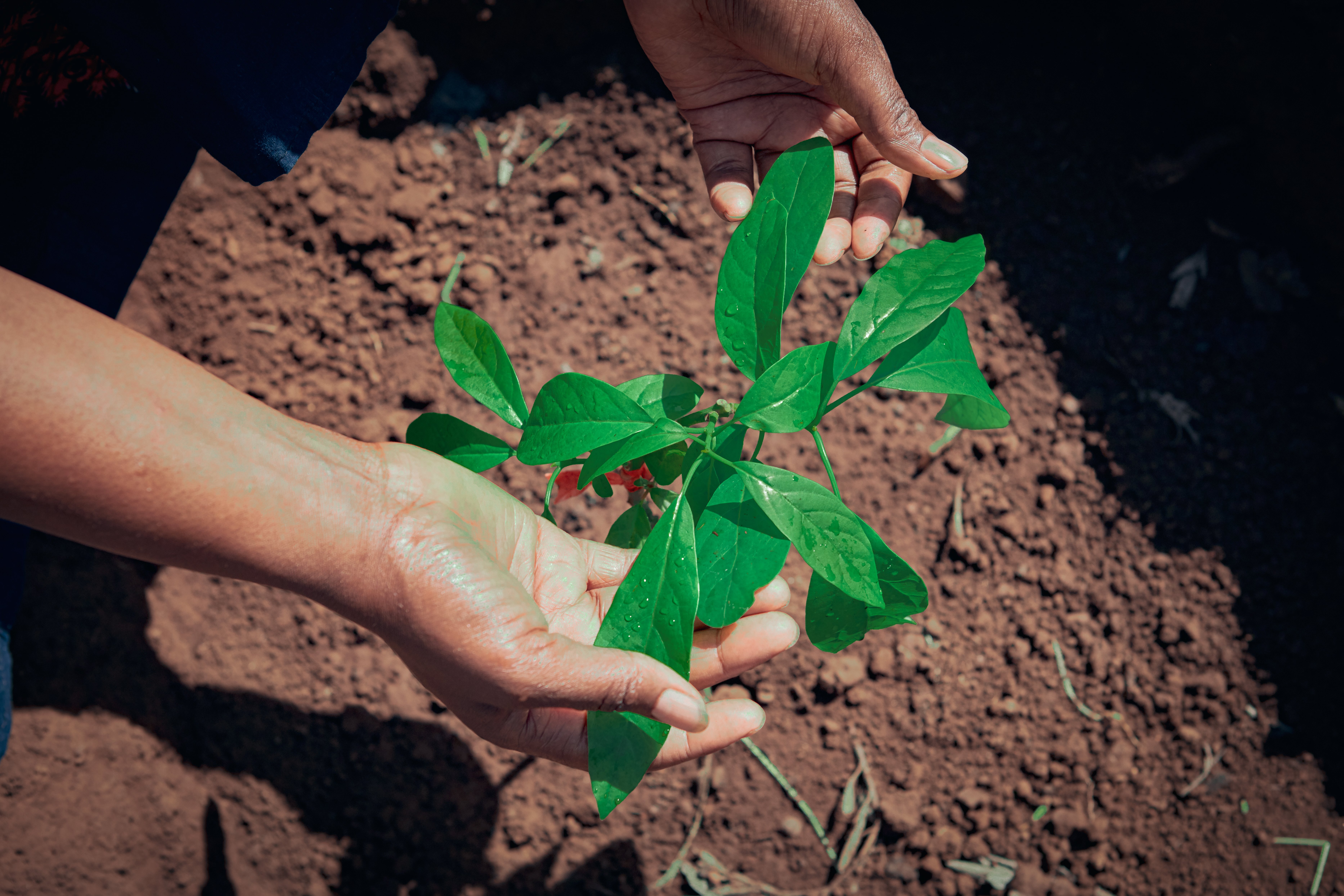
Saying that Africa is “the continent of the future” has almost become a cliché. But there is some truth in it—if we take it seriously. Because many of the balances of the future—environmental, agricultural, social—are already being built there.
The way soils are managed today, how trees are integrated into agricultural systems, how production is made sustainable—these will all have effects in the decades to come. And trees are a concrete lever within this process.
At this point, the initial question changes shape. No longer: “Why do you plant trees in Africa?”
But: “Where does it make the most sense to plant them?”
In contexts where:
- the soil needs to be regenerated
- agriculture can become more resilient
- trees can make a difference in people’s daily lives
Planting trees here is not just a symbolic gesture. It’s an operational choice, working within real systems.
Seeing it better, acting better
It all starts with how we look. If Africa is larger than we imagine, it is also more complex. And more interesting. And more decisive.
Correcting a map doesn’t change the world. But it can change the way we read it. And from there, the way we act.
Planting a tree in Africa today means entering this story through a concrete door, helping to build systems that work better, right where they are growing.
If you want to do it, you can start here. 👉 Plant a tree in Africa with Treedom.

